




When we think about technological revolutions, our minds instantly wander to the flashy consumer innovations that dominate our daily feeds. We track the launch of ultra-slim smartphones, marvel at high-tech electric vehicles, and scroll through the latest public software trends.
However, the most profound technological transformation isn’t happening on the surface of our screens. It is taking place quietly, deep within the operational infrastructure of the modern business world.
Behind closed doors, organizations are completely rewriting how they manage data, protect assets, and deliver value. This silent transformation is entirely reshaping old industries, making them unrecognizable to competitors stuck in the past. Here are five massive digital shifts happening behind the scenes that you need to know about.
1. Migrating to Decentralized Cloud Infrastructures

For decades, corporate data lived on dusty, physical servers locked away in basement IT closets. If a power outage struck or a hard drive failed, operations ground to a painful, expensive halt.
Today, businesses are aggressively shifting toward highly flexible, minimalist professional workspace and decentralized cloud ecosystems. This architecture does more than just back up files; it allows teams spread across different continents to compute, build, and collaborate in real-time.
By removing the reliance on physical hardware, companies gain the agility to scale their digital resources up or down within minutes, instantly matching shifting market demands without heavy upfront investments.
2. Leveraging Invisible Machine Learning Protocols
Artificial intelligence dominates headlines, but its most practical business applications are completely invisible to the casual observer. Companies are quietly weaving machine learning algorithms directly into their standard backend software.
These tools handle the monotonous heavy lifting that used to bottleneck human workers. They scrub massive databases for errors, predict supply chain disruptions weeks before they happen, and automate complex inventory distribution.
Instead of replacing workers, this shift frees up human minds to focus on creative strategy, product innovation, and deep relationship building.
3. The Quiet Revolution in Proactive Defense Architecture

As businesses migrate their vital operations to virtual spaces, the threat landscape shifts dramatically. Traditional firewalls and basic anti-virus software are no longer enough to protect sensitive consumer data or proprietary trade secrets.
Bad actors have grown highly sophisticated, forcing organizations to completely change how they approach digital defense. Rather than waiting around for a breach to happen and reacting in a panic, forward-thinking enterprises are investing in a comprehensive zero-trust model. Partnering with top-tier cybersecurity services in Utah allows companies to deploy constant automated monitoring, end-to-end data encryption, and advanced behavioral analysis. This invisible layer of defense stops malicious activity before it ever touches critical data, ensuring total business continuity.
4. Transforming Raw Analytics Into Predictive Intelligence
In the early days of corporate computing, data collection was purely retrospective. Companies would look back at quarterly spreadsheets to figure out what went wrong three months ago.
The modern backend shift has turned data collection into an active, predictive navigation system. Through advanced telemetry and automated business intelligence tools, companies parse millions of real-time data points simultaneously.
This allows executives to spot subtle behavioral trends, anticipate customer churn, and optimize their pricing models on the fly, transforming data from a simple historical record into a powerful crystal ball.
5. Automating Internal Communication and Task Management
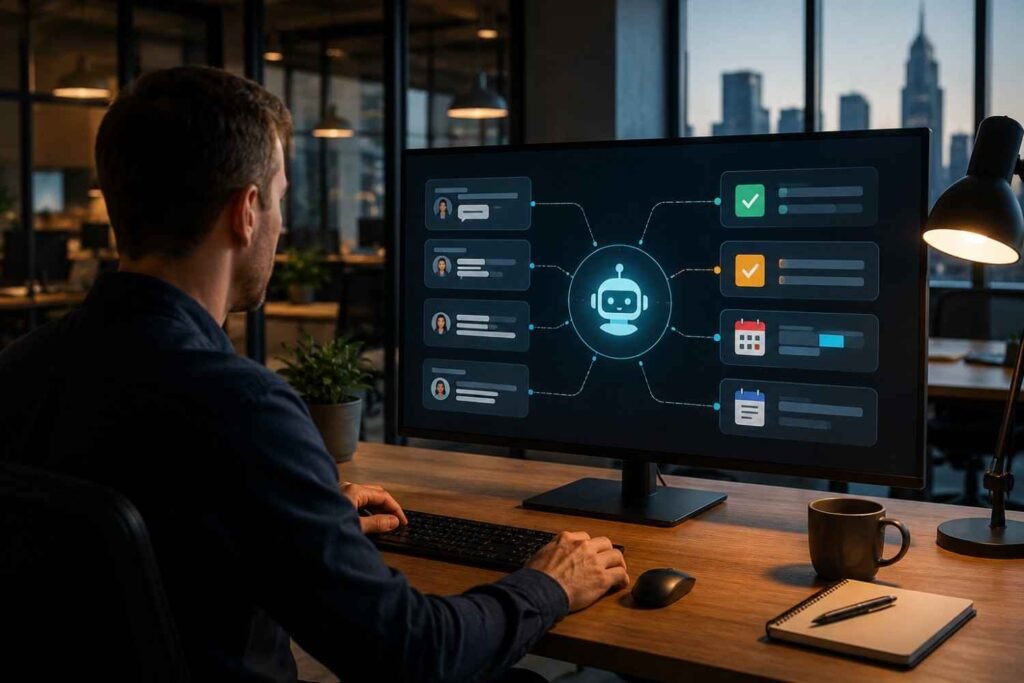
The physical office layout has largely vanished, replaced by an intricate web of asynchronous communication tools. Behind the scenes, the traditional corporate hierarchy is flattening out.
Project management platforms and automated notification systems ensure that workflows route themselves to the right expert without requiring constant middle-management oversight.
When a developer finishes a line of code, the system automatically checks it for errors, updates the project roadmap, and pings the quality assurance team for review. This eliminates the friction of endless email chains and keeps projects moving forward seamlessly.
Conclusion
The true power of the modern digital shift does not lie in flashy user interfaces or hyped social media apps. It resides in the quiet, methodical optimization of the systems that keep our global economy running.
By upgrading to flexible cloud frameworks, leveraging smart automation, and building impenetrable digital perimeters, businesses are laying the groundwork for a more stable future. Innovation is no longer an occasional luxury; it is a continuous, invisible process. The organizations that thrive tomorrow will be the ones that understand how to harness the quiet power shifting behind the scenes today.