





Have you ever watched someone walk into a crowded room or step onto a stage and instantly capture everyone’s attention? They haven’t said a word yet, but their energy is palpable. We often label this elusive quality as “star power,” “unspoken charisma,” or “executive presence.”
The biggest misconception about having a strong public presence is that you have to be born with it. Many assume it is an inherent trait reserved exclusively for natural extroverts.
In reality, public presence is not an innate gift; it is a collection of intentional, physical, and mental behaviors. By turning these behaviors into daily routines, anyone can learn to project confidence, authority, and warmth.
Here are five core habits that top leaders, speakers, and executives practice to master their public presence.
1. Perfecting Open Body Language and Posture
How do you use posture to improve public presence? You can project instant authority by maintaining an open posture—keeping your shoulders rolled back, your spine straight, your hands visible, and avoiding crossed arms or hunched shoulders.
Before you even open your mouth to speak, your body has already communicated a narrative to everyone in the room. Humans are biologically wired to read nonverbal communication cues within milliseconds to assess whether someone is a leader, an ally, or a threat.
When you slouch, cross your arms tight against your chest, or bury your hands deep in your pockets, you are subconsciously trying to make yourself smaller. The public reads this as anxiety, defensiveness, or a lack of preparation.
- The Grounding Technique: Stand with your feet exactly shoulder-width apart. Distribute your weight evenly across both feet rather than shifting back and forth from leg to leg. This eliminates nervous pacing and projects an unshakeable foundation.
- Open Hand Gestures: Keep your palms open and facing slightly upward or outward when speaking. This signals honesty, transparency, and invitation, instantly putting your audience or conversational partners at ease.
2. Mastering Controlled Speech and the Power of the Pause
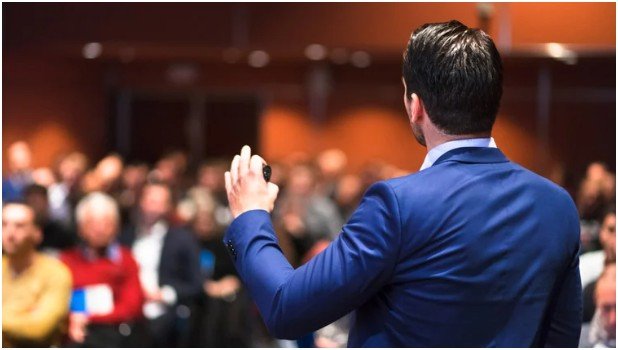
How does speaking slower improve your authority? Speaking at a measured pace and utilizing strategic pauses eliminates filler words, gives your audience time to digest your points, and signals that you are entirely comfortable owning the room.
When adrenaline spikes during a presentation or networking event, our natural instinct is to rush through our words to get the experience over with as quickly as possible. This rapid-fire speaking cadence is a primary indicator of nervousness. It also leads to a reliance on distracting filler words like “um,” “uh,” “like,” and “so.” So you need to understand what really causes anxiety while talking to others and work on that.
To combat this, practice slowing your speech down by roughly 15% to 20% compared to your casual conversational speed. When you transition between major ideas, insert a deliberate two-second pause.
To the untrained eye, a pause feels like an eternity of awkward silence. To your audience, however, that pause builds immense dramatic tension, makes your statements land with heavier emotional weight, and shows that you are not intimidated by the silence.
3. Practicing the 3-Second Eye Contact Connection Rule
Eye contact is the ultimate currency of human connection. If your eyes are constantly darting around the ceiling, scanning the floor, or glued to your presentation slides, you completely sever your connection with the room.
Instead of treating an audience or a meeting room as a singular, overwhelming crowd, break it down into individuals. Practice locking eyes with one specific person for an entire sentence or a complete thought—typically about three to five seconds—before smoothly moving your gaze to someone else.
This habit does two things simultaneously. First, it forces you to slow down and speak more conversationally, which is a major component of professional communication skills. Second, it makes every individual in the room feel as though you are speaking directly to them, transforming a cold lecture into an intimate, high-impact dialogue.
4. Prioritizing Active Listening over Fidgeting
A commanding public presence isn’t just about how you perform when the spotlight is on you; it is equally about how you behave when someone else is speaking. True charisma is a two-way street.
Many people spend their listening time simply waiting for their turn to speak, which often manifests as subtle fidgeting, checking their watch, or looking past the speaker to see who else is in the room. This instantly destroys your perceived warmth and authority.
When someone else is talking, commit your entire focus to them. Tilt your head slightly forward, nod occasionally to validate their points, and repeat key phrases back to them before offering your own perspective. By making the other person feel heard and important, you paradoxically elevate your own presence and influence within that space.
5. Protecting Your Smile and Refining Your Personal Presentation

A genuine, uninhibited smile is the fastest way to signal warmth, competence, and accessibility. However, your visual presentation goes beyond clothing choices; it centers heavily around your personal comfort and self-assurance. If you are constantly hiding your face or modifying your expressions because you feel self-conscious, the room will pick up on that internal friction and misinterpret it as aloofness or insecurity.
This is why foundational self-care and personal health play an overlooked role in building executive presence. When individuals struggle with noticeable aesthetic concerns—such as missing or broken teeth—they routinely hold back their expressions, mumble their words, or avoid smiling altogether during critical introductions.
Investing in your physical health directly translates into raw confidence. For example, individuals looking to restore their natural, uninhibited expressions frequently turn to permanent restorative treatments; exploring options like advanced dental implants in Wasilla or consulting local cosmetic professionals can eliminate the anxiety of a damaged smile, allowing you to speak, laugh, and engage with public spaces with absolute freedom.
Myth vs. Fact: Public Presence Realities
- Myth: To have a strong public presence, you need to be the loudest, most aggressive person in the room.
- Fact: True presence is rarely loud. The most commanding figures often speak softly but with such precise clarity, measured pacing, and grounded body language that the entire room naturally quiets down to hear them.
- Myth: Introverts are at an inherent disadvantage when it comes to public charisma.
- Fact: Introverts often possess an exceptional public presence because their natural inclination toward deep listening, thoughtful pauses, and targeted, highly analytical speaking styles resonates deeply with audiences looking for substance over flash.
Public Presentation Checklist
Before walking into your next high-stakes meeting, presentation, or networking event, take a quick 60 seconds to run through this physical checklist :
- [ ] Shoulders: Rolled back and relaxed, not shrugged up toward your ears.
- [ ] Hands: Free, out of pockets, and ready to use for natural, open gesturing.
- [ ] Jaw: Unclenched, allowing for clear vocal articulation and an easy smile.
- [ ] Feet: Firmly planted on the ground, shoulder-width apart to prevent swaying.
- [ ] Breathing: Deep, diaphragmatic breaths to lower your heart rate and stabilize your vocal tone.
Summary of Presence Habits
Developing a powerful public presence is a continuous practice of alignment. By anchoring your posture to project stability, regulating your speech rate to convey control, and using structured eye contact to build individual connections, you dismantle public anxiety. Pair those traits with deep, active listening and a healthy, uncompromised smile, and you transform how you interact with any room.
Ultimately, presence isn’t about changing who you are; it is about refining your habits and self-care for a confident, radiant appearance so that your internal expertise and natural authority can shine through clearly without any physical barriers getting in the way.