




People who’ve lived through something painful often describe the aftermath with a mix of confusion and self-judgment. They wonder why they can’t just move on. Why certain sounds or smells pull them back without warning. Why they feel exhausted all the time, or on edge, or emotionally flat.
Or why they react to things in ways that don’t match the moment they’re actually in. Understanding what’s actually happening in the brain and body after a distressing experience doesn’t make those responses disappear, but it does something important: it makes them make sense.
The Brain’s First Job Is Survival
When something threatening or overwhelming happens, the brain’s primary job is to keep you alive. It doesn’t pause to evaluate the situation philosophically. It activates a survival response designed to mobilize the body to fight, flee, or in some cases freeze until the danger passes.
The part of the brain that drives this response, the amygdala, operates faster than conscious thought. It registers threat and triggers a cascade of physiological changes before the thinking part of the brain has had a chance to weigh in. Heart rate increases. Breathing changes. Stress hormones flood the system. Muscles prepare for action. This is the nervous system doing exactly what it was designed to do.
The problem isn’t the response itself. The problem is what happens when the threat passes but the system doesn’t fully return to baseline.
When the Nervous System Gets Stuck
In most situations, the stress response activates, the threat resolves, and the body gradually settles back into a regulated state. But when an experience is overwhelming enough, or when the circumstances don’t allow for complete resolution, the nervous system can remain in a state of partial activation long after the event itself has ended.
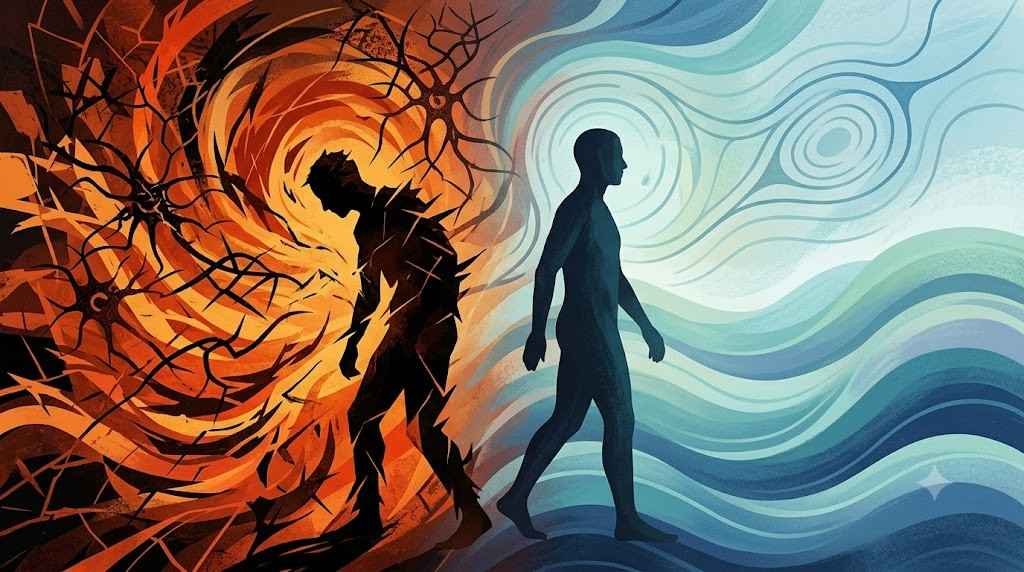
This isn’t a failure of willpower or emotional strength. It’s a physiological reality. The body is doing what it does in the presence of perceived danger, even when the rational mind knows the danger is no longer there. The nervous system doesn’t distinguish cleanly between a memory and an actual current threat. A sound, a smell, a situation that resembles the original experience in some way can activate the same response and cause anxiety triggers that the original event triggered.
This is why someone can be sitting in a perfectly safe room and feel genuinely unsafe. The signal isn’t coming from the room. It’s coming from inside a nervous system that hasn’t yet learned that the threat is over.
What This Looks Like in Daily Life
Dysregulated stress responses show up in a wide range of ways, and not all of them look like what most people picture when they think of distress.
Hyperarousal
Some people remain in a state of heightened alertness that doesn’t switch off. They’re easily startled, have difficulty sleeping, feel irritable or on edge, and find it hard to concentrate because some part of their attention is always scanning for danger. This can look like anxiety, anger, or hypervigilance, and it often exhausts the people experiencing it because maintaining that level of activation takes enormous energy.
Hypoarousal
Others move in the opposite direction, into a kind of emotional numbness or shutdown. They feel disconnected from their own feelings, from other people, and sometimes from a sense of being fully present in their own life. This can look like depression, apathy, or what some people describe as just going through the motions. It’s the nervous system protecting itself by reducing input when the input has been too overwhelming to process.
Intrusion
Some people experience the past breaking into the present in vivid, unwanted ways: flashbacks, nightmares, intrusive thoughts that arrive without invitation and are difficult to dismiss. The memory isn’t being recalled so much as it’s being re-experienced, because the brain never fully processed and filed the original event as past.
Why These Responses Make Complete Sense
None of these responses are signs of weakness, instability, or permanent damage. They’re signs that something overwhelming happened and the system hasn’t yet had the support it needs to integrate that experience and move it into the past where it belongs.
The nervous system learned something during a period of threat. It’s still applying that learning. The goal of healing isn’t to erase what happened or to stop the nervous system from doing its job. It’s to help the system update its understanding that the threat is over, so that the level of vigilance it’s maintaining no longer has to match what was needed during the original experience.
This is exactly where working with a skilled clinician makes a real difference. Approaches like EMDR, somatic work, and other evidence-based methods work directly with the nervous system’s stored responses, not just with the cognitive understanding of what happened. Trauma therapy in Draper draws on several of these approaches, tailored to the specific person and what their nervous system needs in order to settle.
How Healing Actually Works

Healing from a distressing experience isn’t about forgetting it. It’s about changing the relationship the nervous system has with the memory. When a difficult experience has been fully processed, it can be remembered without the body responding as if it’s happening again. The memory stays, but it loses the charge that makes it intrusive or overwhelming.
That shift doesn’t happen through effort or willpower alone. It happens through a process that helps the nervous system complete what it started during the original experience, and learn, at a physiological level, that the threat has passed.
Conclusion
The brain and body respond to distressing experiences in ways that are entirely logical, even when they feel anything but. The responses that follow don’t mean you’re broken. They mean your nervous system did what it was built to do, by choosing broader health approach it may need some support to find its way back to a settled baseline.