



The modern professional landscape has undergone a radical transformation, turning the domestic sphere into a primary place of business. Among the various rooms in a house, the kitchen—often referred to as the “heart of the home”—is the most tempting and treacherous workspace.
It offers immediate access to caffeine and snacks, yet it is also the epicenter of household distractions, from the siren song of a half-full dishwasher to the rhythmic hum of the refrigerator.
Successfully navigating a workday while stationed near the kitchen requires more than just a laptop and a chair; it demands a strategic psychological and physical approach. To maintain a high level of output without succumbing to the “domestic gravity” of the kitchen, consider these six productivity hacks designed to help you thrive in the center of your home.
1. Establish a Strict “Pre-Flight” Kitchen Reset

The psychology of a workspace is heavily influenced by visual clutter. When your peripheral vision is filled with last night’s dinner plates or an overflowing recycling bin, your brain subconsciously registers these as “unfinished tasks.” This creates a cognitive load that competes with your professional responsibilities.
Before you open your laptop for the first time in the morning, perform a ten-minute kitchen reset. This isn’t a deep clean; it is a tactical strike to clear the surfaces. Load the dishwasher, wipe down the primary counter, and ensure the sink is empty.
By clearing the “visual noise” of the kitchen, you provide your brain with a clean slate, allowing you to focus on complex professional problems rather than the domestic chores waiting in the corner of your eye.
2. Designate a “Work-Only” Surface Zone
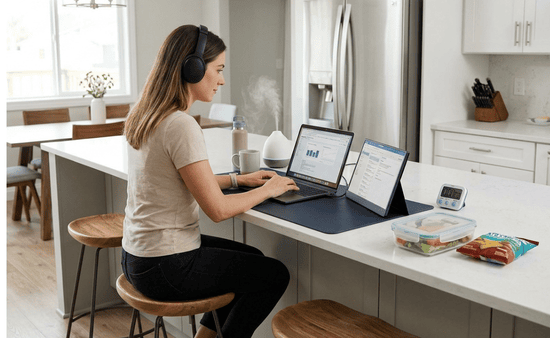
One of the greatest challenges of working near the kitchen is the lack of physical boundaries. The kitchen island often doubles as a breakfast bar, a homework station, and a mail sorting facility. To combat this, you must claim a specific section of the surface as a “work-only” zone during business hours.
If you don’t have a separate desk, use a visual anchor to signal this shift. This could be a specific desk mat, a portable monitor, or even a particular lamp. When these items are present, the space is an office. When they are put away, the space reverts to a kitchen.
This ritualistic setup and teardown helps your brain transition in and out of “deep work” mode, preventing the professional and personal lives from bleeding into an unproductive gray area.
3. Optimize the Floor Plan for Dual Functionality
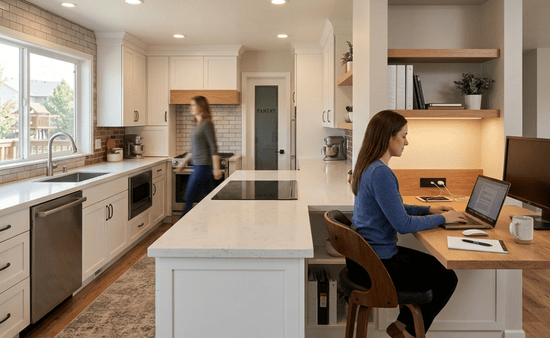
Efficiency in a home workspace is often a matter of ergonomics and traffic flow. If you find yourself constantly shifting your chair to let someone reach the pantry or feeling cramped by the proximity of appliances, the layout itself may be the bottleneck. A poorly designed kitchen-adjacent workspace can lead to physical strain and frequent interruptions.
For many homeowners, the solution lies in structural changes that better accommodate the hybrid lifestyle. Modern residential design increasingly prioritizes “pocket offices” or extended islands that provide a dedicated tech-ready area.
If your current configuration feels like a constant battle against the architecture of the room, exploring kitchen remodeling in Layton can be an effective way to reconfigure the footprint. By integrating built-in charging ports, ergonomic seating heights, and better lighting, you can transform a chaotic high-traffic area into a streamlined professional hub that still serves its original domestic purpose.
4. Leverage the “Kitchen Timer” for Deep Work Sprints
The kitchen is equipped with one of the most powerful productivity tools ever invented: the timer. The Pomodoro Technique—a time-management method involving 25-minute bursts of work followed by a 5-minute break—is particularly effective when working near the heart of the home.
Use your oven timer or a physical kitchen timer to “game-ify” your focus. Commit to staying in your seat and avoiding the refrigerator until the bell rings. When it does, use that five-minute break to perform a domestic task—like switching the laundry or starting a pot of coffee—to satisfy the urge to be productive at home. This allows you to indulge your domestic instincts in controlled intervals rather than allowing them to derail your entire afternoon.
5. Curate a Professional Sensory Environment

The kitchen is a sensory-rich environment, often filled with the smells of food and the sounds of appliances. While these can be comforting, they are rarely conducive to high-level concentration. To maintain your professional edge, you must take control of your auditory and olfactory surroundings.
Invest in high-quality noise-canceling headphones to mask the hum of the dishwasher or the sound of the ice maker. Furthermore, be mindful of “food coma” scents. While the smell of slow-cooking chili is pleasant, it can act as a subconscious signal to your brain that it’s time to relax and eat.
During work hours, opt for “alert” scents like peppermint or citrus using a small diffuser. These scents are associated with increased focus and can help keep your energy levels high during the mid-afternoon slump.
6. Proactive Nutritional Planning to Avoid “The Graze”
Proximity to the pantry is a double-edged sword. While it’s convenient, the temptation to engage in “procrastivity”—the act of doing something “productive” like making a snack to avoid a difficult work task—is immense. To stay focused, you must treat your kitchen-adjacent workday like a day at an external office.
Prep your lunch and snacks the night before or first thing in the morning. Having a pre-set “menu” prevents you from wandering into the kitchen and spending twenty minutes staring into the fridge wondering what to eat. By making your nutritional decisions ahead of time, you preserve your “decision fatigue” reserves for your actual work.
When it is time to eat, move away from your work surface to a different part of the kitchen or dining room. This physical separation ensures that you are actually taking a break, allowing you to return to your work zone refreshed rather than sluggish.