




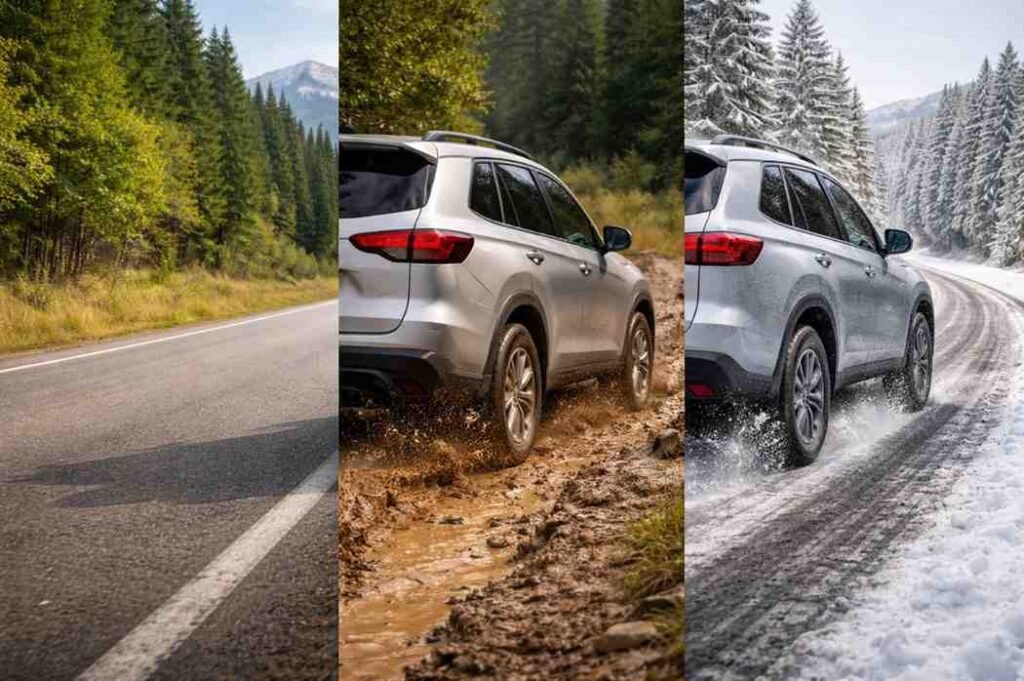
One of the most critical decisions a vehicle owner can make is the selection of the appropriate set of tires. The rubber that touches the road determines the braking range of your car. Its stability in taking corners, and its consumption. Nonetheless, as the market is flooded with specialization category. Most ordinary drivers are unable to differentiate among all-season, all-terrain, and winter tires.
These variations are not solely a technical triviality, but it is one of the key elements in assuring road safety and in the longevity of the parts of your car in the multifarious conditions of 2026 roads.
1. Functional Objectives: Categorization of the Core Tires
Each tire is designed to have a certain operating window, which is a range of temperatures and surface conditions in which the tire functions optimally. The main distinction between these three categories is the purpose. All-season tires are made to meet the needs of the average commuter who has to deal with wet and dry conditions on the road during moderate weather.
All-terrain tires are designed to be used in many ways, and it suits people who alternate their time on the highways and off-road trails. Winter tires are very specific devices and can be used only under the below-zero temperature conditions and in the presence of frozen precipitation.
Most drivers go through tire reviews & Pickyourtires just to get real-world testing information against what the manufacturer claims to know whether these engineering goals have really made it to the road. These resources show that a tire can be rated as a condition, but its execution would be largely dependent on the type of rubber technology applied by the brand.
2. Traction Engineering: Comparison of Tread Design and Mechanics
The most obvious difference between the types of tires is the tread pattern. It is the point where the water is either deflected, drills into snow, or gets hold of dry asphalt.
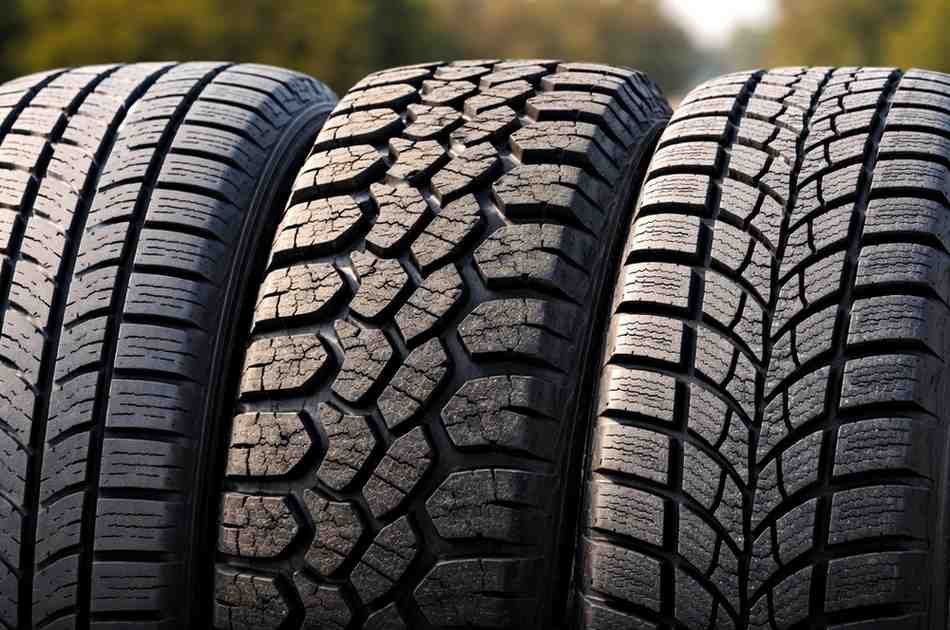
The Main Tread Characteristics by Category:
- All-Season Patterns: Characterized by moderately deep grooves of either symmetry or asymmetry. They are tuned to ride smoothly and add water efficiently on the smooth surfaces.
- All-Terrain Patterns: They are also characterized by wide gaps (voids), large, and coarse tread blocks. This design enables the tire to self-cleanse itself of mud and gravel and also offers edges on which to hold uneven rocks.
- Winter Patterns: Characterized by small holes or sipes, which are thousands in number. These sipes serve as thousands of little biting edges which cling to ice, and the deeper grooves are shaped so as to pack in the snow (contact on snow gives better grip than contact on ice of rubbers).
3. Material Science: The Contribution of Thermal Adaptability
The flexibility of the rubber compound of a tire is a major determinant of the grip that a tire has. At extreme temperatures of either too cold or too hot. And rubber will harden or soften, respectively, and cease functioning by not being able to stretch into the shape of the road, or by becoming excessively soft and tearing itself apart in use.
Compound Behavior Across Temperature Ranges:
- All-Season Compounds: Designed to remain pliant in a broad temperature span, usually between room temperature (or higher) to about 7°C (45°F).
- All-Terrain Compounds: They are normally fortified with silica or carbon black to avoid the problem of “chipping” and “tearing” during driving over sharp rocks or rough debris.
- Winter Compounds: This is designed with high silica content to be soft and pliable even in the very low temperatures that are below zero, hence the tire is not made to become hard plastic on frozen roads.
4. Operational Impact: Comfort, Noise, and Fuel Efficiency
To the average motorist, the tires must make a great deal of difference in everyday life in the cabin. Though safety is of paramount importance, one should not overlook the secondary impacts on one’s wallet and on one’s ears.
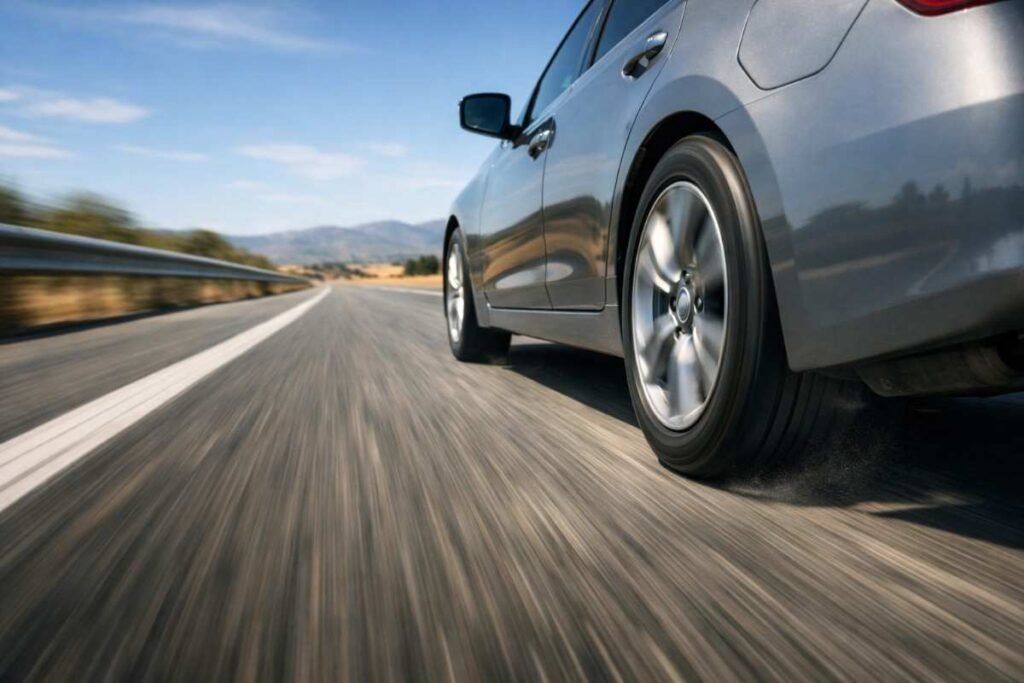
The Efficiency and Comfort Matrix:
- Noise Profiles: The tires are quietest since all-season tires are closed-shouldered. The all-terrain tires have their open tread blocks that give a clear sound of being in a hum, or growl when faster on the highway.
- Fuel Economy: All-season tires have minimal resistance to rolling, hence have an excellent MPG. All-terrain tires are heavy and aggressive with a tread pattern that is difficult to move, which can reduce fuel consumption by 3 to 5 percent.
- Ride Quality: Winter tires can be squishy or sluggish when used on dry and hot roads since the soft rubber and deep treads are more prone to moving under the weight of the car.
5. Usage Analysis: Assessing Everyday Driving Performance
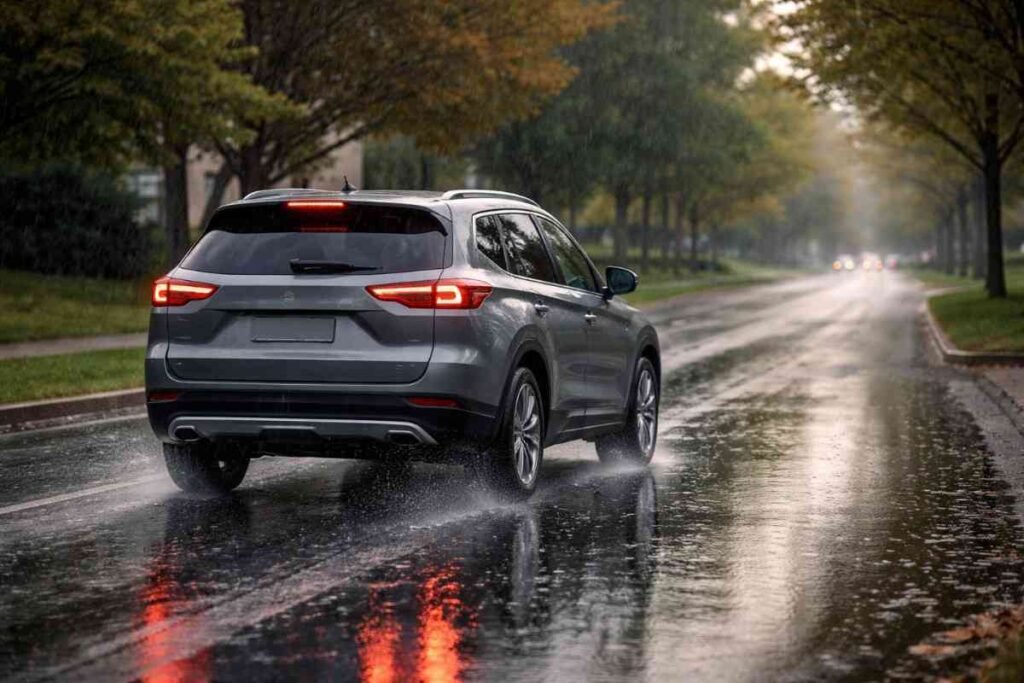
The place you drive is equal to the way you drive. The needs of a city commuter in the rainy climate are extremely different. As compared to those of a driver in the mountainous region. All-season tires are the best when it comes to stop-and-go traffic in the city and offer the best braking stability on damp asphalt. But they may prove to be dangerous in thick slush or deep snow.
All-terrain tires allow drivers to have a safety net. In case they run into mud or any light snow in their weekend outings. This includes managing construction equipment vehicles. But still have to keep up to speed on the highway during their working week. They provide roughness not found in all-season tires. But they might not provide the accuracy in handling needed to take corners at high speed on dry pavement .
6. Lifecycle Management: Longevity and Durability Factors
The tire lifespan does not concern only the number of miles covered, but also the environment in which the same is covered.
Wear and Replacement Indicators:
- All-Season Longevity: This type usually has the best mileage guarantees, with most being between 60,000 and 80,000 miles as long as they are rotated periodically.
- All-Terrain Longevity: Although the tread is strong against punctures, the aggressive tread will be subject to uneven wear unless the alignment of the vehicle is maintained in perfect condition.
- Winter Longevity: These tires have the shortest life as they are misused. In temperatures above 10°C (50°F) drive winter tires. The soft rubber will be destroyed quickly – it may lose much of the tread in a single warm season.
7. Strategic Selection: Making the Final Decision for Your Vehicle
To find the appropriate tire, you need to do a sincere evaluation of your typical winter. In the parts of the world where the weather seldom falls below the freeze line and where snow is a mere dusting. It is possible to be satisfied with an all-season tire that has high quality.
When you often have to travel on roads that are not tarmac or have to do construction. The all-terrain tire can provide the required durability. But in a snow belt area where the ground is often white for months. A special set of winter tires is an indispensable safety measure.
Balancing Road Safety versus Long-Term Value
Specialization is highlighted in the shift to the driving landscape of 2026. Although all-in-one solutions are convenient, it is usually compromised under extreme conditions. Knowing the mechanical variation in the design of the tread, rubber elasticity, and fuel efficiency. It will enable ordinary drivers to choose a tire that perfectly suits their local weather and individual driving patterns.
You would always want to consult expert tire reviews Pickyourtires. So that you come up with the most reliable data relating to your vehicle model. In that way, you would have made a bold investment that would not only ensure your safety. But also your vehicle performance in the long run.