




We have all been there. You press create, and in a few seconds, you are staring at a thousand words on your screen. It’s efficient, it’s grammatically perfect, and it’s… incredibly boring. By the year 2026, AI as a luxury is a thing of the past in the digital world. But with the web being reloaded with synthetic prose, the human touch has soared to a high.
Readers nowadays are able to detect a robot a mile away. The robotic drafts are more of a template, employing meaningless words of beige color and phrases of transitioning, such as in conclusion or it is important to note that, with discouraging frequency. In order to really get to an audience, you must crack the code of the machine. You must infuse heart, sexiness, and impulsiveness into the dual. It is not just a matter of editing to turn a sterile draft into a living conversation; it is a matter of alchemy.
To make your brand be seen in an automated world, you need to understand how to make it humanize, to make it touch hearts rather than computers.
The Anatomy of a “Robot” Draft: Diagnosing Monotonous Syntax and Predictable Patterns

Before fixing the issue, one must understand its symptoms. Despite their sophistication, AI models fundamentally operate as advanced prediction systems. They choose the most statistically likely next word, which often leads to a flattened, repetitive reading experience.
- Foreseeable Sentence Length: AI adores a medium-length sentence. The speech of human beings is not regular. We make short punches. After which, they pursue them with long, flowing descriptions which wind like a river.
- The “As An AI” Syndrome: Robots are talking like a lecturer, even when they are not talking. They do not have the perspective of I and me, which creates trust between a writer and a reader.
- Over-Optimization: Robotic drafts tend to recycle keywords in a clumsy manner. They make such an effort to appease Google that they lose sight of the person on the other end of the screen.
The Human Touch Toolkit: 5 Expert Strategies to Humanize AI-Generated Text
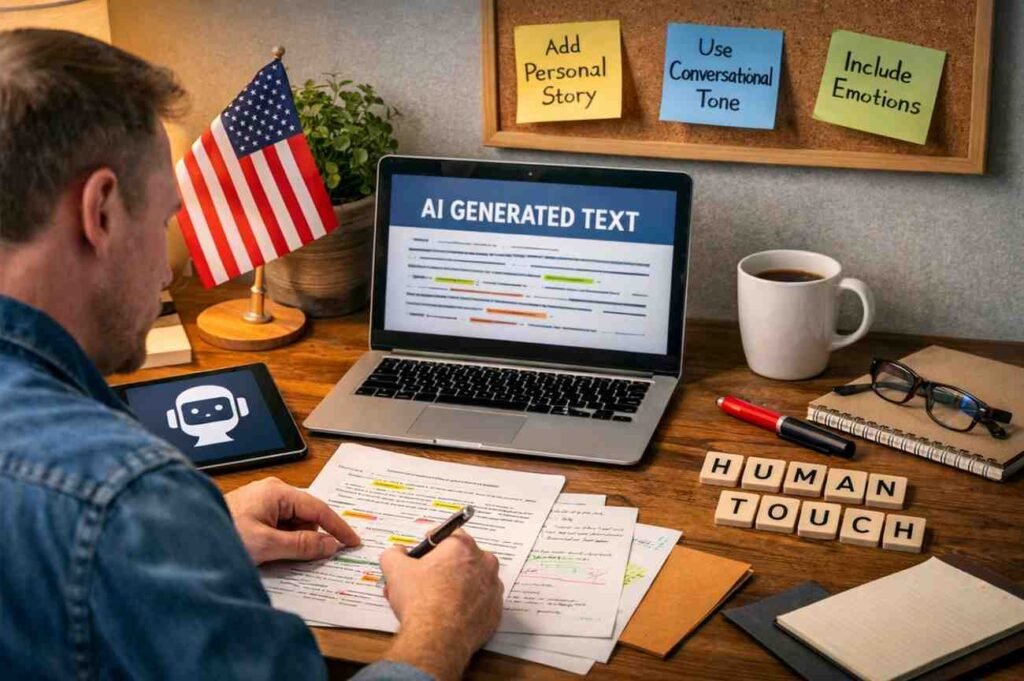
To transform a robotic draft into a human one, it is necessary to make some surgical technology trends. This is the method of stripping off the silicon and adding the spirit:
- The Litmus Test of Reading Aloud
When you stutter while reading a sentence aloud, it was not written by a human being.
- The Band-Aid Vow: trim down long sentences that seem to be tongue-twisting. Include shortenings (do not to don’t) to make the text sound more like a conversation.
- Inoculation of Personal Anecdotes
AI does not get a childhood, a local cafe, or a reminiscence about that occasion when he or she failed at a driving exam.
- The Fix: Toss in a hasty I remember when or I have found that. Even a personal observation as small as that can be used as an authenticity anchor.
- Mastering Perplexity and Burstiness
In linguistics, “burstiness” describes the variation in sentence length and structure. While AI can generate burstiness, it is humans who naturally embody it in their writing.
- Fix: Add in a sentence with two words. Write one thirty-word long, then. This alternation of rhythm makes the brain of a reader active and avoids the effect of a drone.
- Replacing Beige Prose with Bold Vocabulary
AI is fond of safe words: comprehensive, ultimate, innovative, and leverage.
- The Remedy: slang (where needed), metaphors, or uncommon adjectives. Rather than using the word effective, refer to it as a total game-changer or the secret sauce.
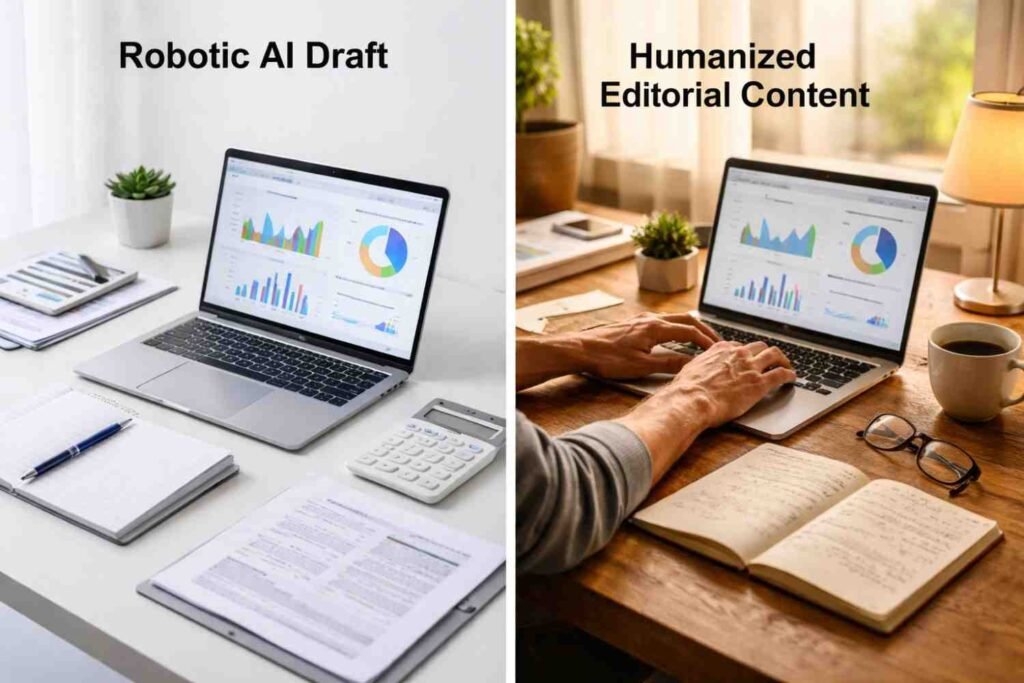
Side-by-Side Comparison: Robotic AI Draft vs. Humanized Editorial Content
| Features |
Robotic AI Draft |
Humanized Editorial Content |
| Tone | Formal, Neutral, Academic | Relatable, Empathic, Witty |
| Vocabulary | Repetitive “Safe” Words | Colorful and Idiomatic |
| Sentence Structure | Uniform and Monotonous | Rhythmic and Spontaneous |
| Core Purpose | Information Delivery | Connection and Persuasion |
| SEO & Ranking | Risk of AI-Content Penalties | Increased User Retention and Shares |
🛠️ The Ethical Edge: Why Effortless Content Transformation Isn’t Lazy
By the year 2026, it will be an effortless transformation that is brought about by the appropriate tools and by the appropriate way of thinking. You are not doing the entire work over; you are polishing the lens.
- Emotional Intelligence (EQ): A man perceives subtext. We understand where we should be sarcastic and somber. Your EQ can be used to tune the vibe of the AI draft to a particular emotional state of your reader.
- Fact-Checking & “Flavor”: AI has the power to hallucinate facts. A human draft is a draft that is based on reality but informed by opinion. It is not enough to make the reader understand a fact; explain why he or she needs that fact.
Expert FAQ: Bypassing AI Detection and Optimizing for Helpful Content
Does Google identify AI?
A: Google has become more advanced in its algorithms. Although they do not penalize AI content per se, they emphasize Helpful Content that is written on behalf of people. When you sound robotic in your content, it will not rank well.
Which is quicker: writing from scratch or editing an AI version?
A: It is much quicker to edit an AI draft on a topic that is research-intensive. The trick is to dedicate 20 percent of the time to creating and 80 percent of the time to humanizing the voice.
What is “Burstiness” in professional writing?
A: It means the difference in the length and structure of sentences. Human writing is characterized by high burstiness (a mixture of short sentences and long sentences).
What can I do to make an AI draft entertaining?
A: Artificial Intelligence humor is usually corny. To put a real laugh on things, self-depreciation, irony, or even using relatable jokes that are known by an insider in your particular industry.
Conclusion: The Future of Digital Storytelling in 2026
In the 2020s, we are not going to fight AI; we are going to dance with it. We have the machine to give us the skeleton–the framework and the information–but furnish the skin–the loveliness and the warmth and the texture. Learning to create the art of the smooth cut, you make sure that your message does not just get on a screen, but on a mind.
Technology can provide the words, but then only you can provide a soul. Once you get the time to digital-presence humanize, you are not merely a content producer, but you are connecting two individuals with examples of IoT applications. Be the standout human in a world of infinite bots.